
FRCA guideline summaries and revision tables
Concise summaries of anaesthesia guidance and high-yield reference tables for FRCA revision: 152 guideline summaries and 120 reference, comparison and classification tables.
Subscriber? Sign in and open GAG from your course.
Guidance you can revise, in a form you can explain
Final FRCA revision means knowing the current guidance for emergencies, critical care and perioperative care, and being able to apply it. Each guideline summary condenses one piece of guidance into an at-a-glance overview and concise tables of what matters for the exam, with the clinical application and exam focus alongside.
The guideline summaries draw on guidance from organisations including the Association of Anaesthetists, the Difficult Airway Society, the Royal College of Anaesthetists, the Obstetric Anaesthetists’ Association, NICE, Resuscitation Council UK, the Faculty of Intensive Care Medicine and the Intensive Care Society.
- Tables you can search, and open full screen with Maximise table.
- Comparison tables that put related drugs, conditions and options side by side.
- Self-test questions and clinical application on many items.
- Related learning links to your course’s own chapters and topics, for example in Final Written and Final Practical.
GAG summarises published guidance for exam preparation. It is educational material, not an official publication of, or endorsed by, any of the organisations whose guidance it summarises. In clinical practice, follow current national and local guidance.
Topics you will find in Guidelines & Tables
A selection of 44 published titles. The topic directory lists all 272.
Airway emergencies
- Unanticipated difficult tracheal intubation in adults (DAS 2025)
- Can't intubate, can't oxygenate (CICO) and emergency front-of-neck airway
- Adult tracheostomy and laryngectomy airway emergencies (NTSP)
- Awake tracheal intubation in adults (DAS 2019)
- Tracheal extubation and the at-risk airway (DAS 2012)
Resuscitation and crises
- Adult cardiac arrest including the perioperative setting
- Peri-arrest and perioperative bradycardia and tachycardia (adult)
- Perioperative anaphylaxis: recognition and immediate management
- Malignant hyperthermia crisis
- Local anaesthetic systemic toxicity (LAST)
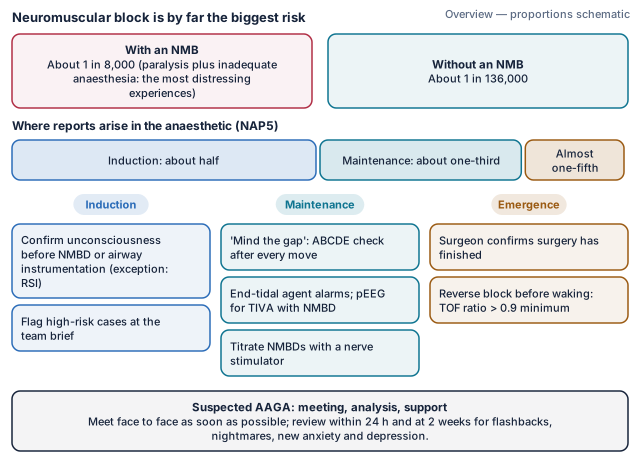
- Accidental awareness during general anaesthesia (NAP5 Handbook)
Blood, transfusion and anticoagulation
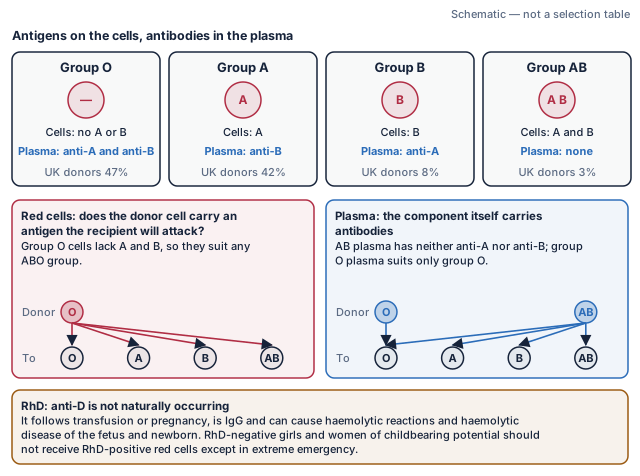
- ABO and RhD blood groups: red cell and plasma compatibility
- Acute transfusion reactions, TACO and TRALI
- Massive blood loss and major haemorrhage (non-obstetric)
- Perioperative management of anticoagulant and antiplatelet drugs
- Regional anaesthesia in patients on antithrombotic drugs or with abnormal coagulation
Critical care
- Acute kidney injury and renal replacement therapy
- Suspected sepsis in adults: recognition, antimicrobials and early management
- ARDS: lung-protective ventilation, prone positioning and extracorporeal support
- Oxygen therapy, high-flow nasal oxygen and non-invasive ventilation
- Safe vascular access and central venous catheters
- Transfer of the critically ill adult
Obstetrics and paediatrics
- Anaesthesia for caesarean birth, including category 1 and general anaesthesia
- Postpartum and major obstetric haemorrhage
- Labour analgesia and failed or inadequate neuraxial block
- Paediatric perioperative care: preassessment, URTI, emergence delirium and recovery
- Paediatric basic and advanced life support
Perioperative medicine and pain
- Preoperative assessment, investigation and optimisation of adults
- Anaesthesia and perioperative care for people living with obesity
- Peri-operative management of diabetes mellitus
- Perioperative pain management in adults
- Postoperative nausea and vomiting: risk, prophylaxis and rescue
Safety, equipment and professional practice
- Checking anaesthetic equipment and breathing systems
- Standards of monitoring during anaesthesia and recovery
- Anaesthesia in MRI and other non-theatre environments
- Human factors in anaesthesia and responding to catastrophes
- Consent for anaesthesia and shared decision-making
- Professional duties: good medical practice, confidentiality, candour and raising concerns
Reference and comparison tables
Side-by-side tables, classifications and scores for rapid revision.
- Intravenous induction agents compared
- Opioid comparison: kinetics, metabolites, organ failure and reversal
- Inhalational agents: MAC, partition coefficients, SVP and metabolism
- Vaughan Williams classification of antiarrhythmic drugs
- KDIGO definition and staging of acute kidney injury
- ASA physical status classification
What a GAG visual looks like
Frequently asked questions
Which guidelines are summarised?
The 152 guideline summaries cover guidance from organisations including the Association of Anaesthetists, the Difficult Airway Society, the Royal College of Anaesthetists, the Obstetric Anaesthetists’ Association, NICE, Resuscitation Council UK, the Faculty of Intensive Care Medicine, the Intensive Care Society. The topic directory lists every published title. GAG does not cover every UK guideline.
Can I use the summaries in clinical practice?
They are written for exam revision. For patient care, use the current full guidance and your local policies; guidance changes, and the summaries are concise by design.
Is GAG endorsed by the RCoA or the guideline authors?
No. FRCA.APP is independent. GAG summarises published guidance for educational purposes and is not an official publication of, or endorsed by, the Royal College of Anaesthetists or any other organisation named.
What is the difference between a guideline summary and a table?
A guideline summary (152 items) condenses one piece of guidance: it opens with an at-a-glance overview, then tables of the key recommendations. The 120 reference, comparison and classification tables set related drugs, conditions, scores or options side by side.
Continue: Graphs & Science · Anatomy · GAG overview
GAG comes with full access to every course
GAG is included in Primary Written, Primary Practical, Final Written and Final Practical, with exam-focus prompts for each.
The free preview does not include GAG.
Already registered? Sign in