FRCA.APP feature · GAG: Graphs, Anatomy & Guidelines

FRCA graphs, anatomy and guidelines — made clear

Concise explanations, clear schematics and high-yield reference tables for Primary and Final FRCA revision.

Learn the diagram. Explain the concept. Carry your revision forward.

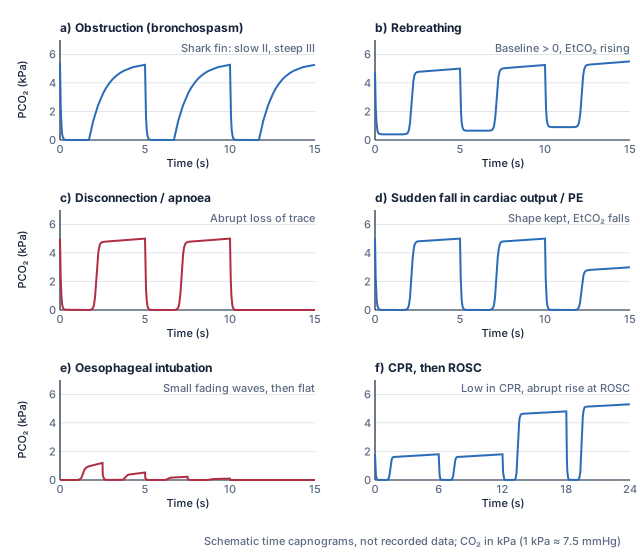
Six schematic time capnograms showing obstruction, rebreathing, disconnection, falling cardiac output, oesophageal intubation and CPR then ROSC.
Abnormal capnograms: obstruction, rebreathing, disconnection, low output, oesophageal tube. Six capnogram shapes side by side, each labelled with the feature that identifies it. Select the image to enlarge it.
591published items
222Graphs & Science
97Anatomy
272Guidelines & Tables

The published GAG catalogue, October 2026. Guidelines & Tables holds 152 guideline summaries and 120 reference, comparison and classification tables.

Three sections

One library for FRCA revision, in three parts

Every item starts from a visual or a table and explains what it shows. The same items appear in all four courses.

Graphs & Science

222 items of physiology, pharmacology, physics, clinical measurement, equipment and statistics: graphs, waveforms, equations and mechanisms.

Examples

  • Abnormal capnograms: obstruction, rebreathing, disconnection, low output, oesophageal tube
  • Cerebral autoregulation: blood flow versus perfusion pressure
  • Context-sensitive half-time and decrement times
  • Flow–volume loops: normal, obstruction, restriction and upper-airway patterns
Explore Graphs & Science →

Anatomy

97 anatomical and sonoanatomy schematics: airway, neuraxis, plexuses, vascular access, the heart and the relations that matter for procedures.

Examples

  • Laryngeal innervation: superior and recurrent laryngeal nerves
  • Interscalene block window: sonoanatomy and the phrenic nerve
  • Conus, dural sac and surface landmarks: lumbar neuraxis in sagittal view
  • Central venous catheter tip position, malposition pathways and confirmation
Explore Anatomy →

Guidelines & Tables

152 concise guideline summaries and 120 reference, comparison and classification tables for clinical anaesthesia, critical care and perioperative medicine.

Examples

  • Can't intubate, can't oxygenate (CICO) and emergency front-of-neck airway
  • Local anaesthetic systemic toxicity (LAST)
  • Malignant hyperthermia crisis
  • ABO and RhD blood groups: red cell and plasma compatibility
Explore Guidelines & Tables →
Why schematics

Diagrams built for understanding, recall and drawing practice

Exam answers often depend on being able to describe a graph, label a structure or explain a mechanism clearly under pressure. GAG’s visuals are drawn for that purpose: they leave out the clutter and keep what you need to explain.

  • Focus on the relationships, labels, axes and mechanisms that matter.
  • Practise describing a graph, and sketching or labelling a diagram from memory.
  • Build a structure for explaining a topic under exam pressure.
  • Use simplified anatomical schematics to understand key relations.
  • Revise clinical recommendations through concise summaries and comparison tables.

The visuals support understanding; they are not a forecast of what will appear in your exam, and not every exam format asks you to draw.

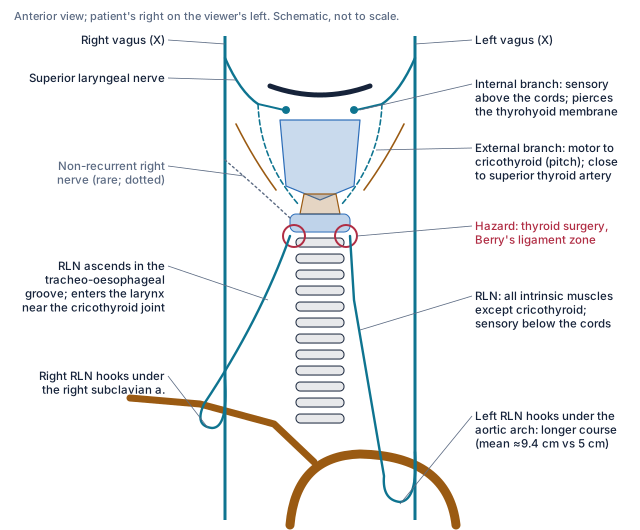
Vagus, superior laryngeal and recurrent laryngeal nerves on both sides, anterior view.
Laryngeal innervation: superior and recurrent laryngeal nerves. Laryngeal innervation as a labelled schematic: the relations that matter, not a photograph. Select the image to enlarge it.
Inside each item

What you can do with a GAG item

Find it fast

Search titles, aliases and topics, then filter by section, system and content type. Items are ordered by what is high-yield for your exam, or A to Z.

Description of the visual

A plain-language description of each graph or schematic, so you can put it into words.

Explain in 60 seconds

A short, structured explanation to read, then say aloud in your own words.

Reveal labels

On labelled diagrams, reveal the labels one at a time to test identification and labelling.

Test me and clinical application

Self-test questions with answers on request, and the clinical application of the topic, where an item has them.

Exam focus

Prompts for each exam, marked high-yield, often examined or background, so you see what matters for the exam you are sitting.

Related learning

Links to related GAG items and to your course’s own chapters and topics on the same subject.

Expandable, searchable tables

Guideline and reference tables you can search and open full screen with Maximise table.

Highlights, notes and your rating

Highlight passages, add notes, ask the FRCA.Ai Tutor about the item, and rate it Not yet reviewed, Needs revision or Confident.

What it looks like

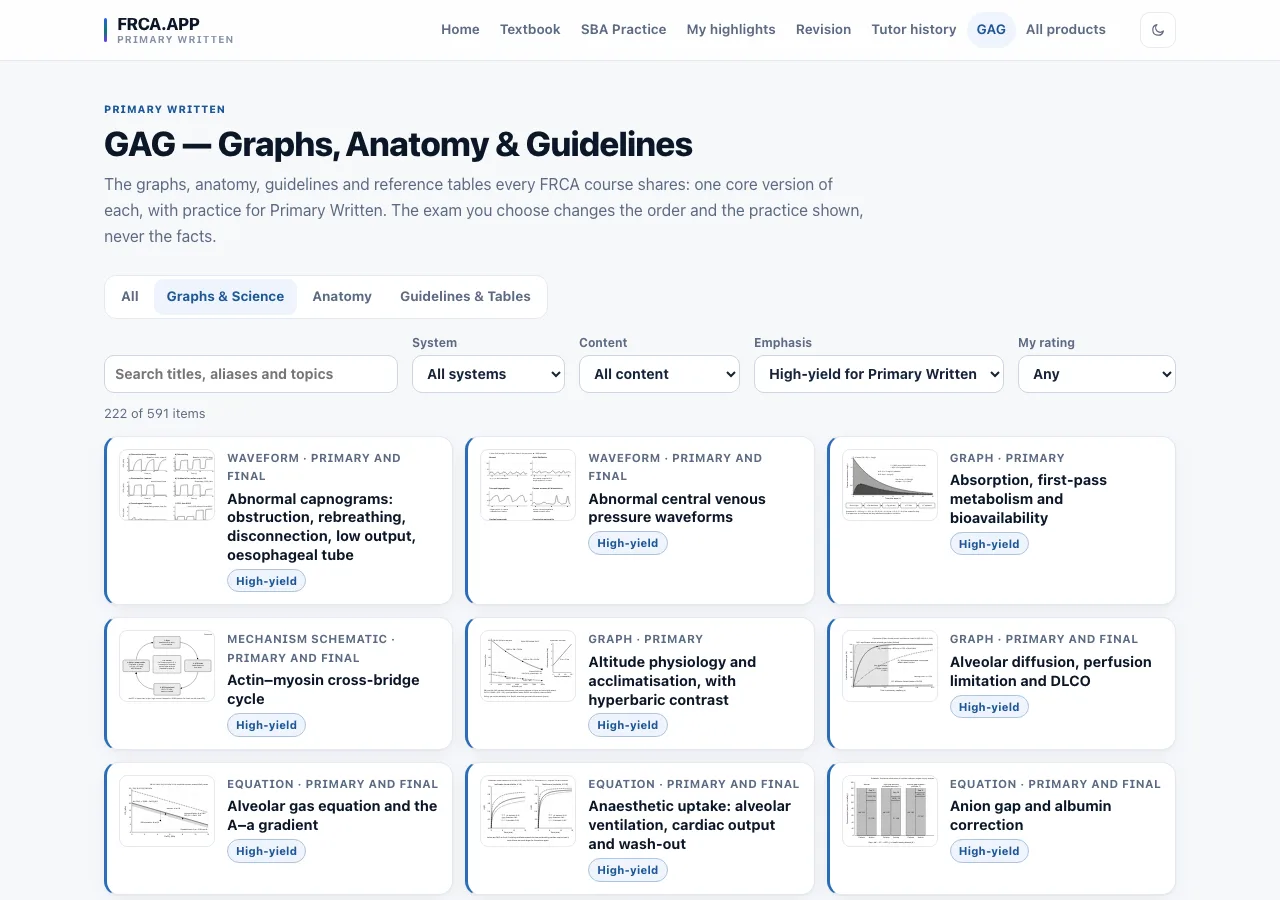
GAG catalogue in Primary Written filtered to Graphs and Science, showing 222 of 591 items with search, system, content, emphasis and rating filters
The GAG catalogue: search and filter, ordered by emphasis for your exam.
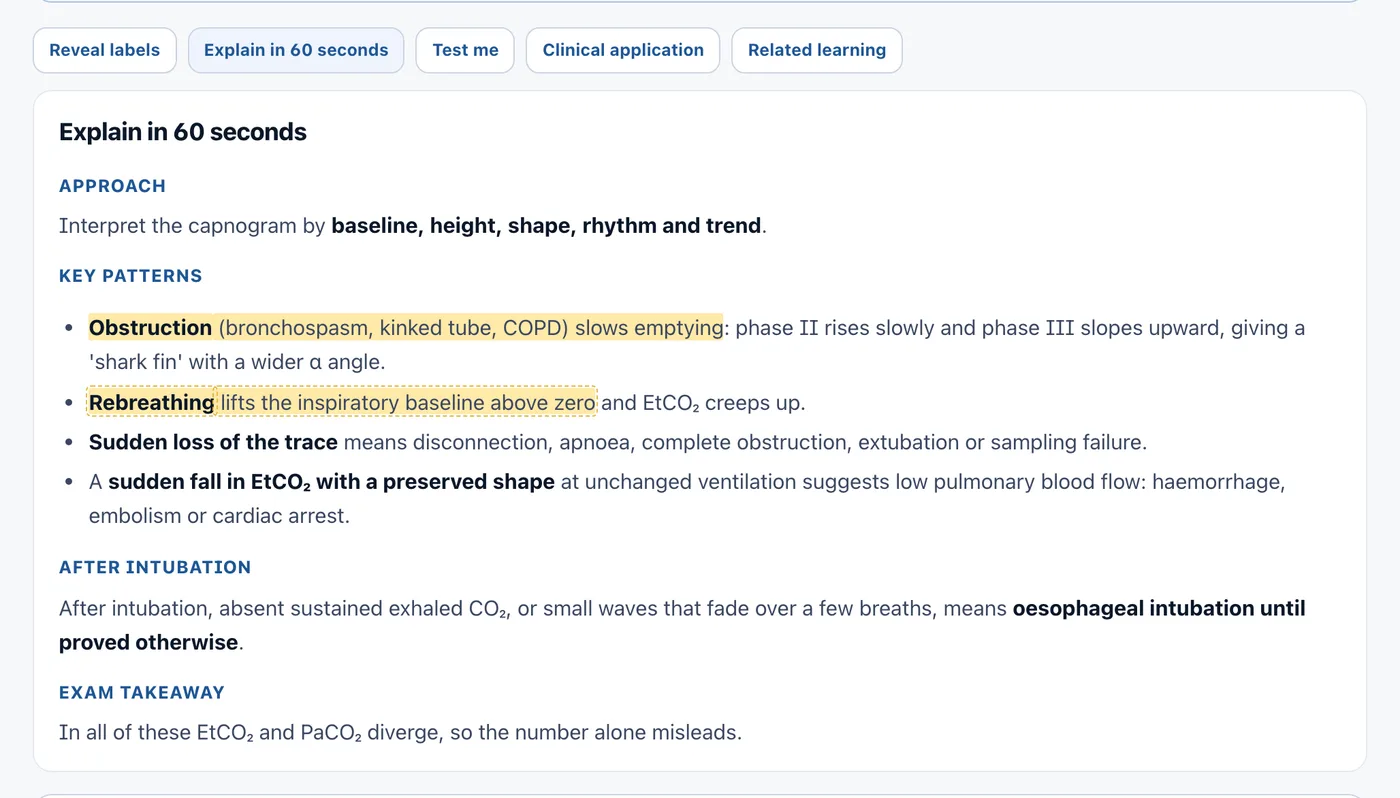
GAG item actions: Reveal labels, Explain in 60 seconds, Test me, Clinical application and Related learning, with the Explain in 60 seconds panel open
Explain in 60 seconds, with the learner’s own highlights shown in the text.

Screenshots of GAG on FRCA.APP, October 2026, taken with a test account. The highlights and note shown were added for illustration. Select an image for a larger view.

Interactive anaesthesia graphs

Move the controls, watch the graph change

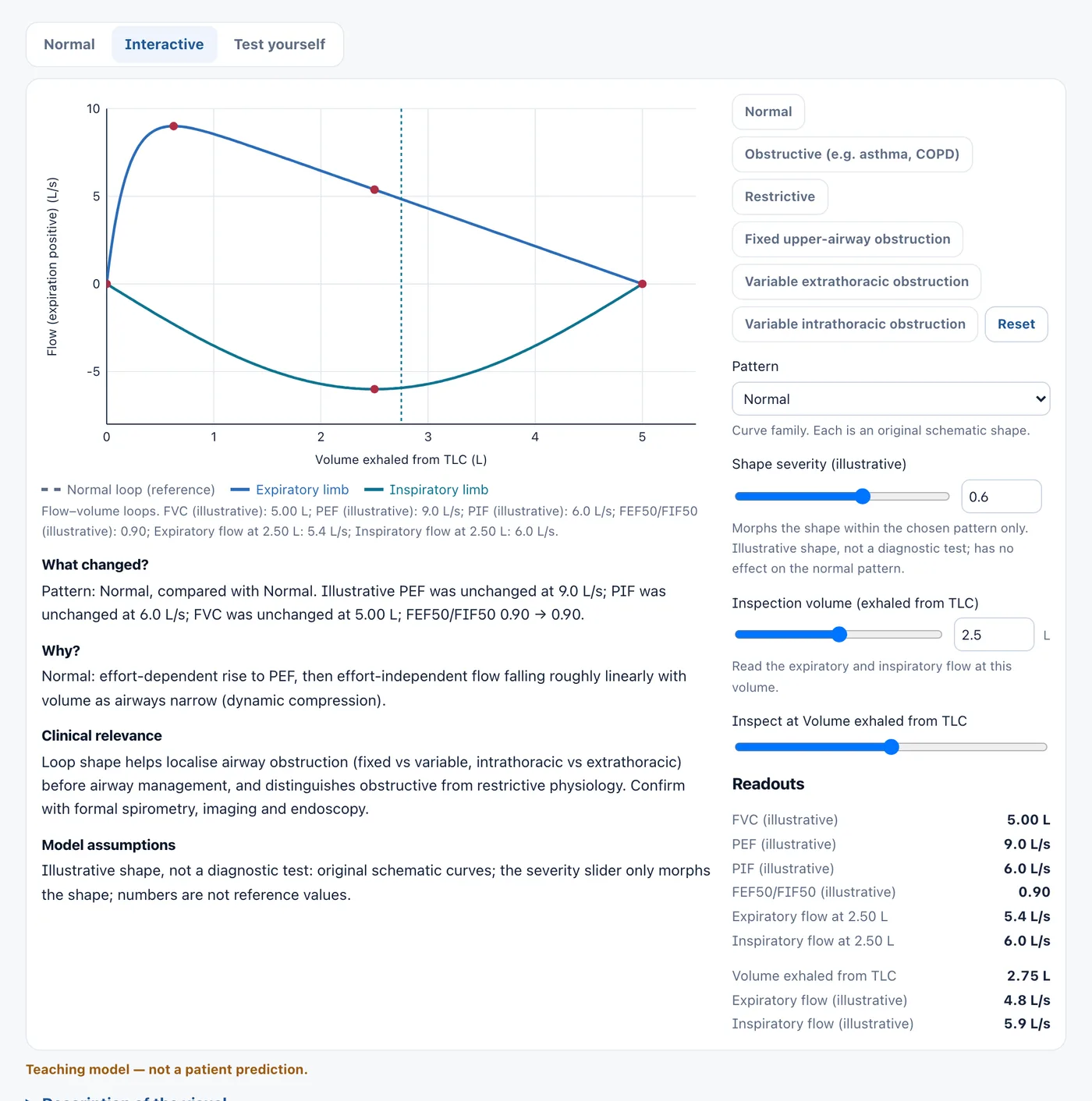
26 of the graph items have an interactive version alongside the drawing. Switch between Normal, Interactive and Test yourself; in Interactive you can choose a pattern, move sliders and read the values as the curve changes shape. Each is a teaching model, not a patient prediction.

Interactive graphs include:

  • Oxygen–haemoglobin dissociation curve and the Bohr effect
  • Flow–volume loops: normal, obstruction, restriction and upper-airway patterns
  • Left ventricular pressure–volume loop
  • Dose–response curves: linear and log axes, potency, efficacy and slope
  • Abnormal capnograms: obstruction, rebreathing, disconnection, low output, oesophageal tube
  • Ventilator traces: peak, plateau, driving pressure, auto-PEEP and time constants

Most GAG items are static diagrams. Only items marked as interactive have adjustable controls.

Interactive flow–volume loop with pattern buttons, a severity slider, an inspection volume control and live readouts
An interactive graph: choose a pattern and move the controls to see the loop change.

Screenshots of GAG on FRCA.APP, October 2026, taken with a test account. The highlights and note shown were added for illustration. Select an image for a larger view.

All four courses

The same items, framed for your exam

GAG is included with full access to each subscription course. The facts stay the same; the order and the exam-focus prompts follow the course you open it from.

Primary Written

Primary Written

For the MCQ and AKT, GAG is a fast way to revise the graphs, equations and physics that questions are built on, and to compare core concepts side by side.

GAG in Primary Written →
Final Written

Final Written

For the Final SBA and AKT, GAG brings clinical application to the fore: concise guideline summaries, comparison tables and the interpretation of traces and results.

GAG in Final Written →
Final SOE and FCPE

Final Practical

For the Final SOE and FCPE, GAG gives you a structure for discussion: the key principles of a topic, its clinical application, and the anatomy and monitoring that sit behind it.

GAG in Final Practical →
FRCA highlights and notes

Highlight it once. Keep it as you progress.

Your GAG highlights and notes attach to the shared item, not to one course. When you move from Primary Written towards Final Practical, the passages you marked are already there: you do not need to highlight them again.

  • Highlights and notes belong to your account and appear wherever that item is available to you.
  • Every course’s My highlights page lists your GAG highlights and notes in one section.
  • If the wording of an item changes later, your quotation and note are kept.

Worth knowing

  • Use the same FRCA.APP account in every course.
  • Access to each course follows your subscription. Saved highlights do not give access to a course.
  • GAG highlights stay with GAG items. Textbook and learning hub highlights stay with those chapters and topics.
  • Your confidence rating for an item is kept separately in each course.

More about highlights and notes →

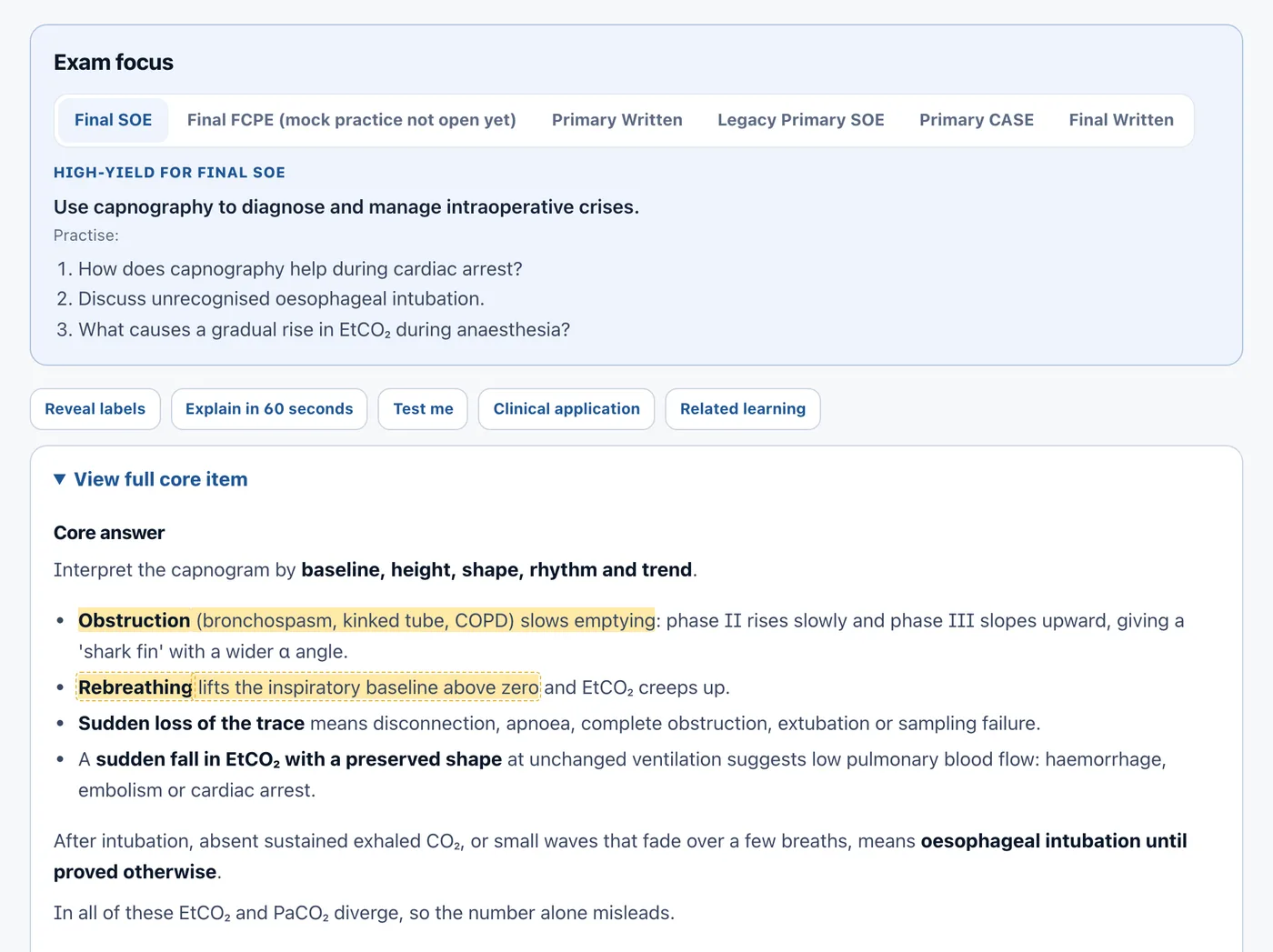
The same GAG item opened in Final Practical, with exam focus for Final SOE and two highlights made earlier in Primary Written
Highlights made in Primary Written, already in place when the same item opens in Final Practical.
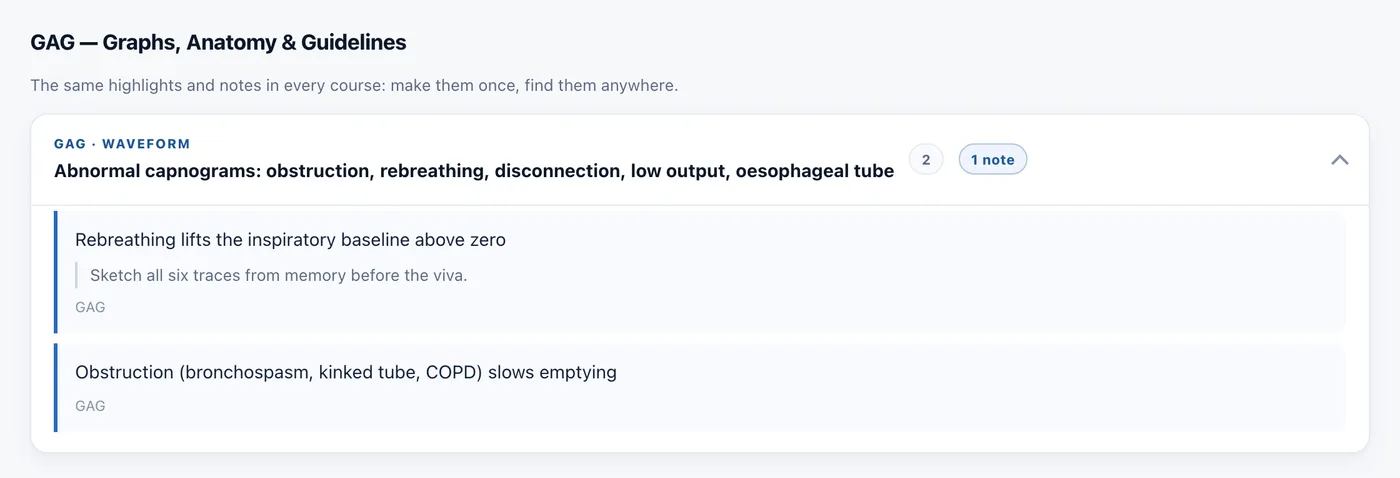
My highlights page in Final Practical with a GAG section listing two highlights and one note on the abnormal capnograms item
GAG highlights and notes collected on My highlights, in every course.

Screenshots of GAG on FRCA.APP, October 2026, taken with a test account. The highlights and note shown were added for illustration. Select an image for a larger view.

How to use GAG

A five-step routine for each topic

  1. Explore the visual

    Start with the graph, waveform, schematic or table. Look at the axes, labels and shape before you read anything.

  2. Read the concise explanation

    Open Explain in 60 seconds, or the full core item, for the reasoning behind the picture.

  3. Explain or sketch it from memory

    Close the page and say it aloud or draw it. Use Reveal labels to check your labelling one label at a time.

  4. Test yourself and follow related learning

    Answer the self-test questions where an item has them, then follow the links to related GAG items and your course’s own chapters and topics.

  5. Highlight and add notes

    Mark the passages you want to keep and add your own notes. They stay with the item as you move between courses.

FRCA guideline summaries

Concise summaries of anaesthesia guidance

Concise summaries of anaesthesia guidance and high-yield reference tables for FRCA revision. The guideline chapters summarise guidance from organisations including the Association of Anaesthetists, the Difficult Airway Society, the Royal College of Anaesthetists, the Obstetric Anaesthetists’ Association, NICE, Resuscitation Council UK, the Faculty of Intensive Care Medicine and the Intensive Care Society.

GAG summarises published guidance for exam preparation. It is educational material, not an official publication of, or endorsed by, any of the organisations whose guidance it summarises. In clinical practice, follow current national and local guidance.

See Guidelines & Tables →

The topic directory

Every published title, grouped by section and system, with a search box. Use it to check coverage before you subscribe.

Browse all 591 topics

Frequently asked questions

What is GAG?

GAG (Graphs, Anatomy & Guidelines) is a library of 591 FRCA revision items inside FRCA.APP: 222 in Graphs & Science, 97 in Anatomy and 272 in Guidelines & Tables. Each item centres on a clear visual or table with a concise explanation.

Which courses include GAG?

GAG is included with full access to each of the four subscription courses: Primary Written, Primary Practical, Final Written and Final Practical. Every course shows the same items, ordered by what is high-yield for that exam, with exam-focus prompts for its own formats.

Can I try GAG free?

Not at present. GAG is part of full access and is not included in the free preview. A free account lets you explore each course’s preview before you subscribe.

Do my highlights and notes carry over between courses?

Yes. GAG highlights and notes belong to your account and the shared item, so when you open the same item in another course you have access to, they are already there. Access to each course still follows your subscription: saved highlights do not unlock a course.

Are all the graphs interactive?

No. Most items are static diagrams designed for understanding and drawing practice. 26 graph items also have an interactive version with controls you can adjust, such as the oxygen–haemoglobin dissociation curve, flow–volume loops and pressure–volume loops.

Is the anatomy realistic or schematic?

Schematic. The anatomy items are simplified, labelled diagrams that show the relations you need to understand and explain. They support, but do not replace, anatomical study with atlases, prosection, ultrasound practice and clinical teaching.

Are the guideline summaries official guidance?

No. They are concise educational summaries for FRCA revision. They are not published or endorsed by the organisations whose guidance they summarise. In clinical practice, follow current national and local guidance.

Does GAG cover the whole FRCA curriculum?

No. GAG concentrates on graphs, anatomy, guidelines and reference tables. Use it alongside the rest of your course: the interactive textbooks and question banks in the written courses, and the learning hub and examiner practice in the practical courses.

GAG comes with full access to every course

Choose the course for the exam you are sitting next. GAG is included in Primary Written, Primary Practical, Final Written and Final Practical.

The free preview does not include GAG.

Already registered? Sign in